If you have ever run payroll for an office, you know the rhythm. Salaried staff, a few hourly people, a time clock, and the same numbers every two weeks. Then you open a home care agency and discover that none of that rhythm survives contact with a caregiver's real week.
A single caregiver might see four clients on Tuesday, drive 38 miles between them, cover a weekend shift for a Medicaid client at one rate and a private-pay client at another, and pick up an overnight on Friday. Every one of those details changes what she is owed. Get one wrong and you either short her paycheck or overpay and eat the margin.
Here is what makes home care payroll its own discipline.
1. You pay by the visit, not the shift
Office payroll counts one block of time per day. Home care counts visits: short, scattered, and often back to back across town. A caregiver can log six or more separate clock-ins in a day. Each one has to be matched to a client, a service, a pay rate and a bill rate.
Visits also change constantly. Clients cancel at the door, hospital stays pause service, a shift runs 25 minutes long because a client fell. Your payroll has to know which of those changes affect pay, which affect billing, and which affect both.
2. Travel time between clients is work time
Under the federal Fair Labor Standards Act, time a caregiver spends driving from one client's home to the next during the workday generally counts as hours worked. The commute from home to the first client and from the last client back home usually does not. Many agencies also reimburse mileage on top of that.
That means payroll needs the gaps between visits, not just the visits. If your system only sees clock-ins and clock-outs, someone in the office is rebuilding travel time by hand every pay period, or nobody is and the agency is carrying wage-and-hour risk without knowing it.
3. One caregiver, many pay rates, one overtime calculation
Home care agencies routinely pay different rates for different work: personal care versus companion care, Medicaid versus private pay, weekends, holidays, overnights, specialized clients. That is normal and fair.
The catch is overtime. When a non-exempt caregiver works more than 40 hours in a workweek at several rates, federal rules generally require overtime based on a blended "regular rate" across all those hours, not simply time-and-a-half of whichever rate came last. Some states add daily overtime or their own rules on top. Hours also stack across clients: four 12-hour weeks split between three families is still 48 hours for one employer.
This is where generic payroll tools struggle most. They expect one rate per employee and someone to hand-calculate the rest.
4. Live-in and 24-hour shifts have their own rules
Live-in care and 24-hour shifts bring questions most employers never face: when sleep time and meal breaks can be excluded from paid hours, what counts as an interruption, and what written agreement you need. The answers depend on federal rules, your state, and how the shift actually went that night.
The federal picture is also shifting. In July 2025 the U.S. Department of Labor proposed restoring the companionship and live-in exemptions for home care agencies and stopped enforcing the 2013 rule that removed them. As of this writing that rule has not been finalized, private lawsuits remain possible, and many states never adopted the exemption at all. Agencies need payroll that can follow whichever rule applies to them, and change when the rule does.
5. The hours must match the EVV record
The 21st Century Cures Act requires Electronic Visit Verification for Medicaid personal care and home health services. EVV records who provided the service, to whom, where, and when it started and ended.
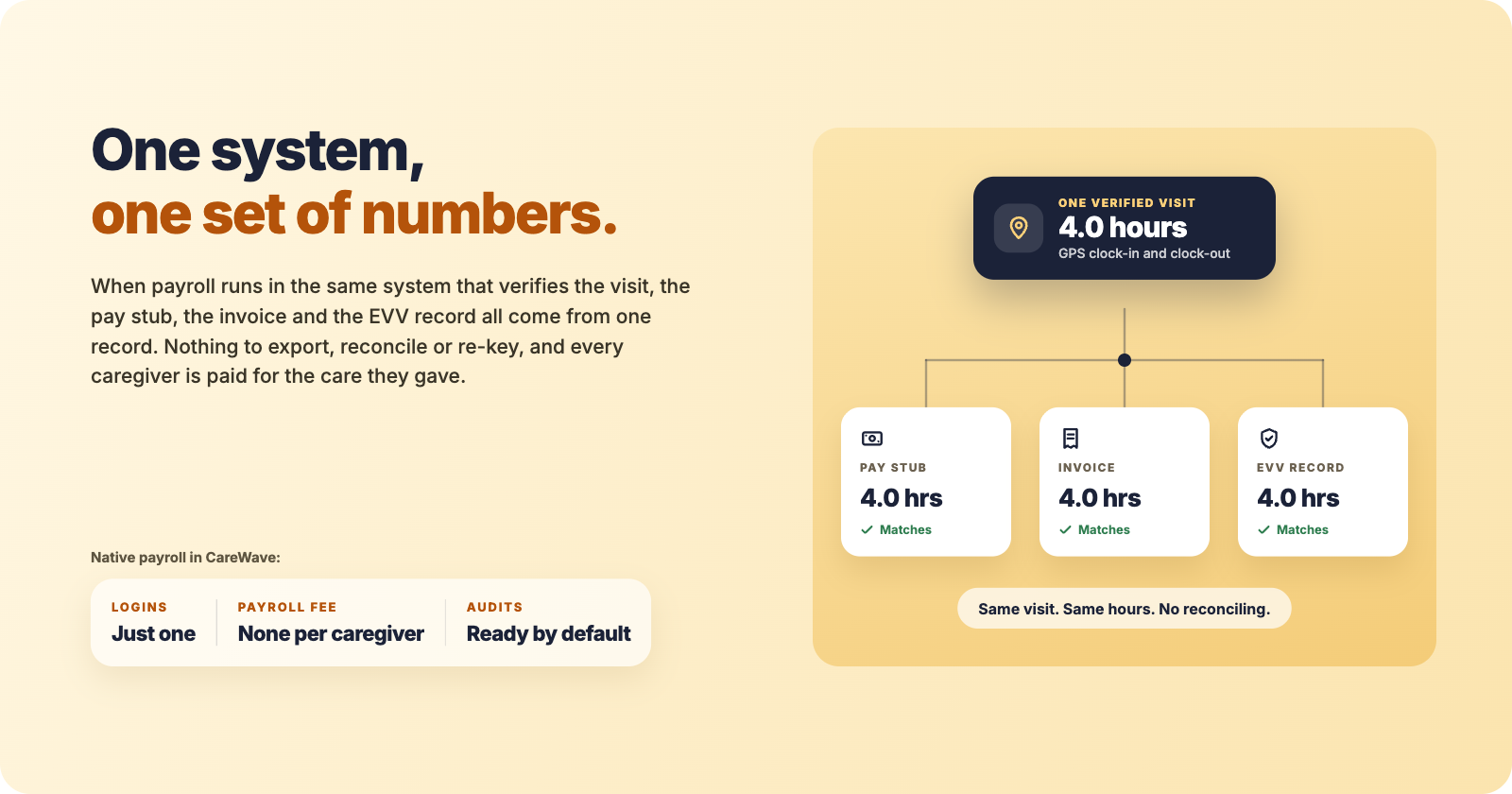
In most industries, payroll and the time clock can disagree a little and nobody notices. In home care, the EVV record, the claim you bill to Medicaid and the hours on the caregiver's pay stub are three views of the same visit. When they disagree, you get denied claims, audit findings, or pay disputes.
6. Payers want to see where the money went
Federal Medicaid rules finalized in 2024 require that, by 2030, at least 80% of Medicaid payments for homemaker, home health aide and personal care services go to direct care worker compensation, with state reporting starting earlier. That provision faces political pushback and may change, and some states already run their own wage pass-through rules.
Either way, the direction is clear: agencies will increasingly need to show, per payer and per service, how much of each dollar reached caregivers. That is a payroll report, and it only works if payroll and billing share the same visit data.
7. Payroll accuracy is a retention strategy
Caregivers are hourly, often live paycheck to paycheck, and have plenty of other agencies to choose from. A paycheck that is short two visits of travel time is not a rounding error to them. It is a reason to leave.
Office payroll can survive a correction next cycle. Home care payroll mistakes cost you caregivers, and replacing caregivers costs far more than getting payroll right.
The bottom line
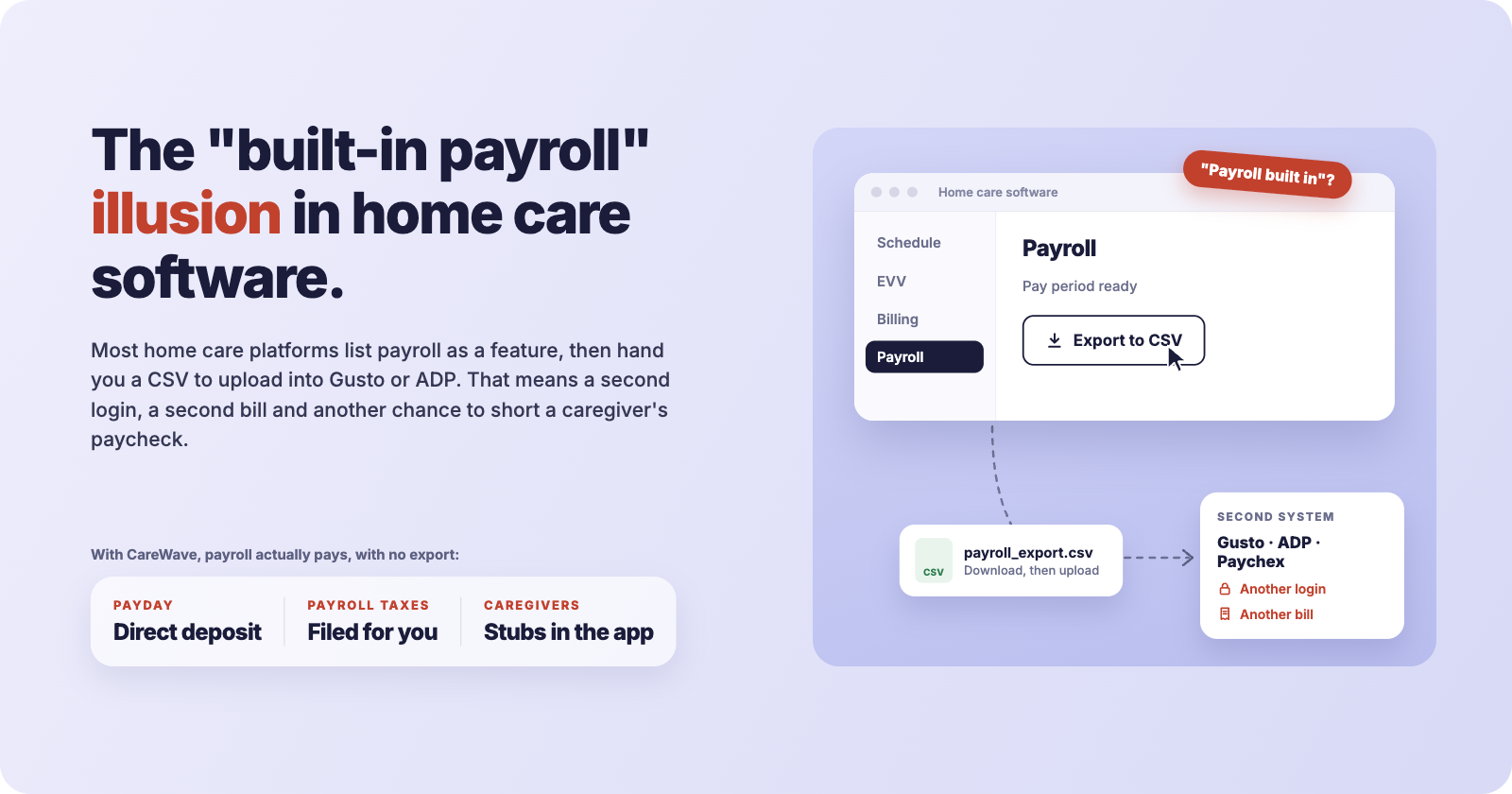
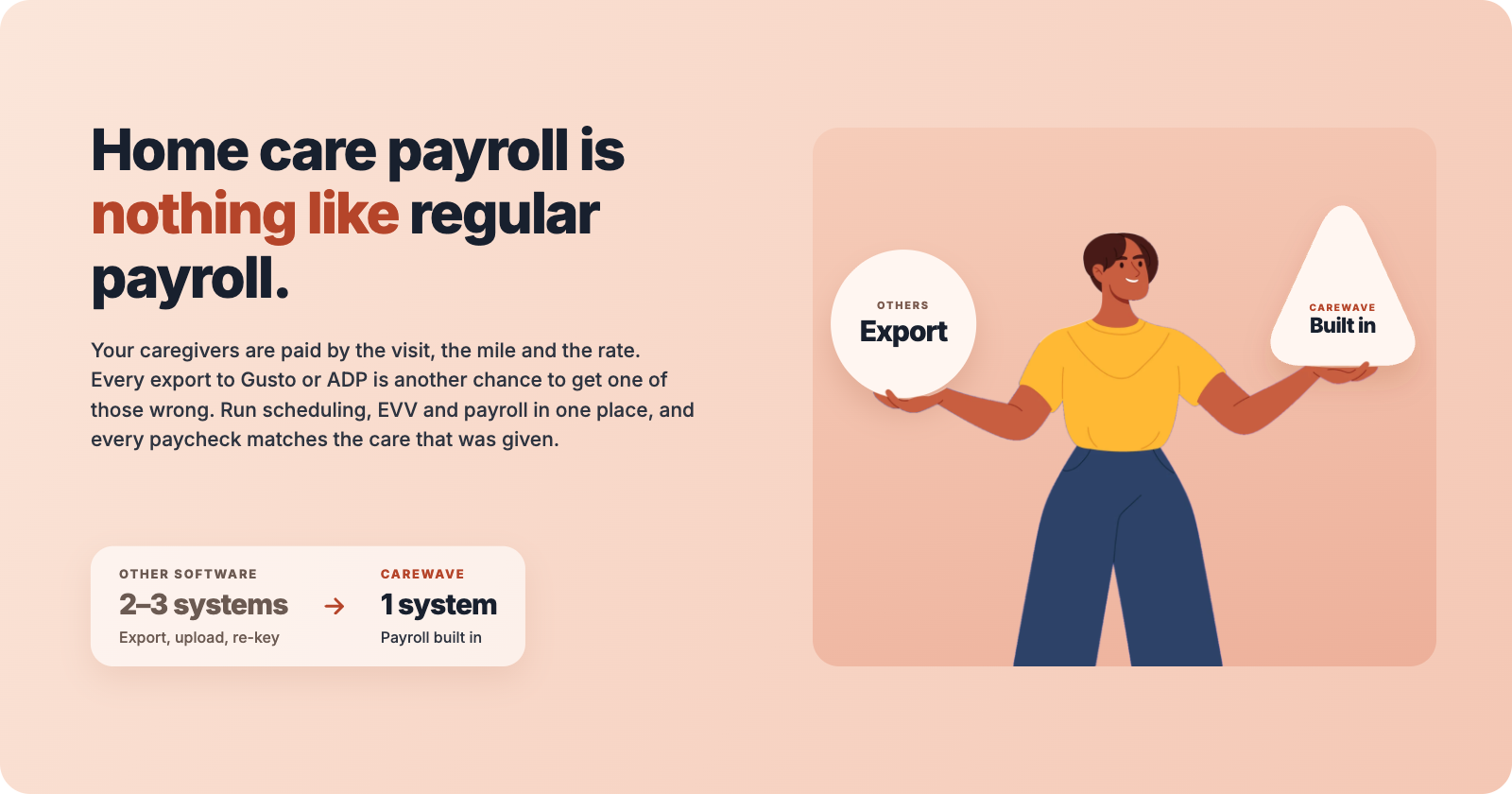
Home care payroll is not ordinary payroll with more employees. It is payroll built on visits, travel, mixed rates, payer rules and EVV, all of which live in your care software, not your payroll provider. That raises a fair question: if all the data lives in your home care software, why does payroll so often live somewhere else?
That is the subject of our next article: The "Built-In Payroll" Illusion in Home Care Software.
This article is general information, not legal or tax advice. Talk with an employment attorney or payroll professional about the rules in your state.